
AI-powered SPC combines traditional statistical process control with machine learning and conversational AI. It monitors multiple process variables simultaneously, detects quality problems earlier than standard control chart rules, and delivers root-cause analysis in plain language — without requiring manual chart interpretation or specialist statistical expertise.
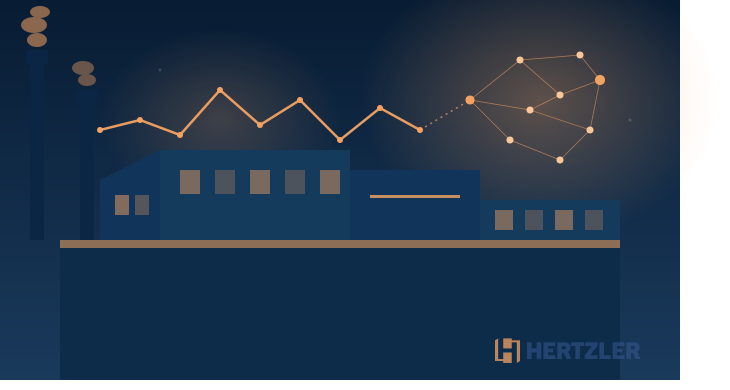
A traditional control chart monitors one variable at a time and raises an alarm after a point crosses a limit.
In a simple, well-understood process, that's sufficient. In modern high-speed manufacturing (where temperature, pressure, material lot, operator, and machine cycle time all interact), it leaves a structural gap.
Walter Shewhart's methodology has earned its place in quality management for a century. The distinction between common and special cause variation, the Western Electric rules, and the discipline of responding only to genuine signals; these remain the right framework.
But the way most plants implement SPC today means the chart can show everything in limits right up until a defective batch ships.
The problem isn't the chart. It's that the chart is only watching one thing at a time and only telling you what has already happened.
SPC's core methodology is sound. Control charts give process owners real-time visibility into process behaviour, and the Western Electric rules provide a disciplined, auditable basis for deciding when to act.
For a stable process with a small number of variables, traditional SPC does exactly what it should.
But four structural constraints become significant in modern manufacturing environments:
These aren't reasons to abandon SPC. They're the precise gaps that AI is built to close.
AI doesn't replace control charts; it extends what they can see, how early they can see it, and how accessible the resulting insight is across the whole team. There are three ways this plays out in practice:
Where a control chart watches one variable, AI monitors hundreds simultaneously. A slight temperature increase, combined with a minor pressure drop and a new material lot, might each sit within their individual limits. Together, they may represent exactly the conditions that led to a high-quality escape last quarter.
AI identifies these multi-variable correlations, patterns that no single X-bar chart would surface, and flags them before a defective part is produced.
Control charts respond to signals after they cross a limit or satisfy a detection rule. Machine learning algorithms can identify the signature of an emerging trend before it reaches that threshold — recognising the early shape of a drift that experience associates with a specific quality problem.
That earlier warning creates an intervention window. The defect becomes preventable rather than discoverable.
Instead of building a query, selecting filters, and drilling through stratified data to understand why scrap increased on a given line, an engineer can ask the question in plain English and receive an answer in seconds.
The analysis that used to take hours of manual work becomes a conversation, and that conversation is available to operators and line managers, not just the quality engineer with a statistical background.
When SPC insight is this accessible, it stops being a specialist tool and starts being a shared operating standard.
AskGS is the conversational AI assistant built directly into GS Premier, Hertzler's cloud-based SPC platform. It's the practical implementation of everything described above (multivariate awareness, early trend detection, and natural language analysis) delivered in the same environment where your SPC data already lives.
When you open a question in AskGS, it already has the context of the charts, Stats Grids, and Insights currently on your dashboard. You don't export data or describe what you're looking at. It knows, because it's been monitoring your live dashboard in real time.
Ask why scrap increased on a specific line, and AskGS cross-references your traceability fields (operator, machine, material lot) to identify what changed and when.
Ask for a process stability summary, and it generates a narrative that flags developing shifts before a formal alarm fires. Hover over any data point and launch AskGS directly for an interpretation of that precise moment — the kind of specificity a generic AI tool cannot offer.
You can also define Global AI Settings that give AskGS plant-specific context: shift times, material grades, and equipment nicknames. Its answers are calibrated to your operation, not built on generalised guidance.
All queries and data processing happen within Hertzler's private controlled network — not through a public AI service. Your process data, machine limits, and operator notes are never used to train external language models. A zero-leak policy ensures your manufacturing intelligence stays within the platform.
For manufacturers in regulated industries or those with strict IT data policies, this is the reason purpose-built industrial AI exists.
GS Premier is Hertzler's cloud-based SPC platform—a self-service system with no on-premises infrastructure required, accessible from desktop, tablet, or smartphone. It's designed to be picked up in minutes and mastered in days: engineers can set up an inspection on their first day and train colleagues the same afternoon.
GS Premier is also engineered for the production floor. If WiFi goes down, data collection continues locally and syncs automatically when the connection is restored, ensuring a continuous, audit-ready record with no gaps. AskGS is built in from day one as an active part of the quality workflow.
When AI is integrated into SPC at this level, the impact is visible in three places:
The future of quality isn't reactive — it's predictive. And the gap between knowing that and having the tools to act on it is narrower than it's ever been.
GS Premier users can see AskGS in action at hertzler.com/ask-gs. Not sure which Hertzler solution fits your operation? Book a conversation with the team.
AI-powered SPC combines traditional statistical process control with machine learning and conversational AI to monitor multiple process variables simultaneously, detect shifts earlier than standard control chart rules, and deliver root-cause analysis in plain language — without requiring manual chart interpretation.
Traditional SPC monitors one variable at a time and flags issues after they cross a control limit. AI-powered SPC monitors hundreds of variables simultaneously, identifies correlated drift patterns that individual charts miss, and can surface a developing quality problem before any single alarm fires.
AskGS is a conversational AI assistant built into GS Premier, Hertzler's cloud-based SPC platform. It monitors live dashboards in real time, cross-references traceability data — operator, machine, material lot — and answers plain-English questions about process stability and root cause. All data stays within Hertzler's private secure network.
GS Premier is Hertzler's cloud-based SPC platform. It provides control charts, descriptive statistics, OEE tracking, and real-time reporting across multiple sites — with no on-premise infrastructure required. AskGS, Hertzler's conversational AI assistant, is built directly into GS Premier.
No. SPC provides the structured, high-quality process data that AI needs to function accurately. AI augments SPC by making analysis faster, broader, and more accessible to the whole team. SPC is the foundation; AI is the intelligence layer built on top of it.
With AskGS, yes. All queries and data processing happen within Hertzler's private, controlled network. Process data, machine limits, and operator notes are never used to train external language models, and a zero-leak policy ensures manufacturing intelligence stays within the platform.

Phil Mason, MBA (June 2026): Phil joined Hertzler Systems Inc. as VP of Business Development in January 2010 and was named President in June 2026.
Links: LinkedIn Quality Magazine FinalScout


