
Your control chart can stay inside its limits and still be warning you that something has changed. This guide explains the eight SPC tests, also known as the Nelson and Western Electric rules, in plain language. For each one, it covers what to look for on the chart and what it usually means on the shop floor. You’ll also learn which tests to turn on first, so you catch real shifts early without drowning your team in false alarms.
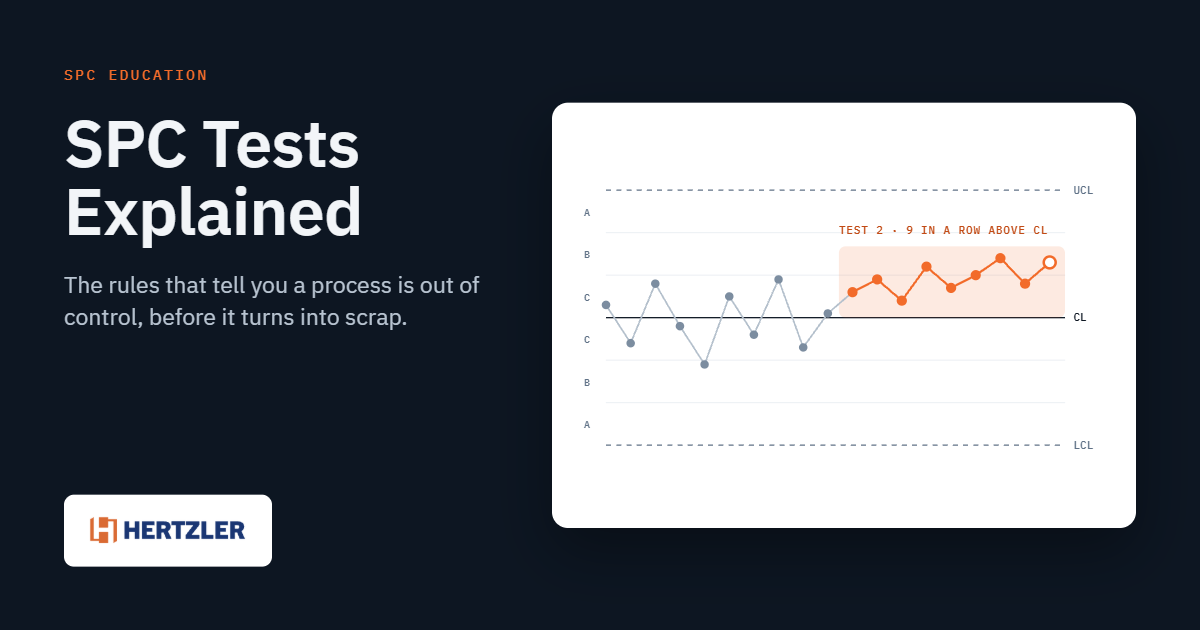
Not necessarily. A control chart can keep every point inside its control limits and still warn you that something on the line has changed.
Picture a fill-weight chart where nine readings in a row sit just above the centerline. None of them breaks a limit, so nothing looks alarming. But a stable process shouldn't land on one side nine times running. Something has shifted, maybe a worn nozzle, a new material lot, or a recalibrated scale, and the giveaway is already costing you product.
SPC tests are the rules that catch these patterns. They turn a chart from a picture you glance at into a system that tells you when to act, often hours or shifts before a part goes out of spec.
An SPC test is a rule that checks a control chart for a pattern that is unlikely to happen by chance alone. When a test fires, it signals special cause variation: something outside the normal running of the process has entered the picture.
Every process has natural, random wobble, called common cause variation. We cover the difference in detail in Common Causes vs. Special Causes of Variation in SPC. SPC tests are how you tell the two apart in practice, so you react to real problems and leave normal noise alone.
Most tests work by dividing the space between the centerline and each control limit into three zones:
In a stable process, about 68% of points fall in Zone C, about 27% in Zone B, and about 4% in Zone A. Patterns that break these odds are what the tests look for.
The most widely used rule sets are the Western Electric rules, published in the 1950s, and the Nelson rules, published by Lloyd Nelson in 1984. Nelson's eight tests include the four Western Electric rules and add four more. Here is each one, with what it usually means on the shop floor.
Start with fewer tests than you think you need. Every test you add makes the chart more sensitive, but it also raises the false alarm rate.
With Test 1 alone, a stable process throws a false alarm roughly once every 370 points. Turn on the four Western Electric rules together and that drops to roughly once every 90 points. Switch on all eight and operators can start seeing alarms on charts that are perfectly healthy. Once people learn to ignore alerts, the chart stops doing its job.
A practical way to set them up:
Also review your control limits regularly. Tests compare new data with the limits, so limits calculated from last year's process will fire too often, or not often enough.
Checking eight rules by eye across dozens of charts isn't realistic. Most out-of-control signals are found late, or never, because nobody had time to look. SPC software runs the tests on every new data point and tells the right person the moment a rule fires.
GS Premier runs on the cloud and checks your data as it's collected, with real-time alerts and dashboards your team can open from a desktop, tablet or phone. Data collection keeps working offline, so inspections continue even when the Wi-Fi drops. Explore GS Premier.
GainSeeker Suite runs on-premise and connects to your MES, PLCs and gauges. Its Python scripting supports deep customization for tailored workflows and complex logic. Explore GainSeeker SPC.
A test tells you that something changed. AskGS, Hertzler's secure conversational AI, helps you work out why. Ask it about a chart in plain language, and it helps you interpret what the data shows and where the process became unstable.
Already a Hertzler customer? See how to set up tests in the SPC Test reference guide.
What is an SPC test? An SPC test is a rule applied to a control chart that flags a pattern unlikely to occur by chance, signalling special cause variation in the process.
What is the difference between Western Electric rules and Nelson rules? The Western Electric rules are four tests from the 1950s. The Nelson rules, published in 1984, are eight tests that include the Western Electric four and add tests for trends, sawtooth patterns and mixed data.
How many SPC tests should I use? Start with Test 1 on every chart, then add tests for shifts and trends on critical characteristics. Using all eight at once raises the false alarm rate.
Does a point outside the control limits mean a part is out of spec? No. Control limits describe what the process does; specification limits describe what the customer needs. A process can be out of control while still making good parts, which is the best time to fix it.
Can SPC tests run automatically? Yes. SPC software can check each new data point against the tests you choose and alert your team when one fires. GS Premier includes real-time alerts as standard.
The right SPC tests, set up well and run automatically, turn your control charts into an early warning system. You find the worn tool, the drifting oven or the new material lot while parts are still in spec, not after a customer complaint.
See how GS Premier and GainSeeker run SPC tests on your data in real time. Request a demo or talk to an SPC expert.

Phil Mason, MBA (October 2026): Phil joined Hertzler Systems Inc. as VP of Business Development in January 2010 and was named President in June 2026.


