
Statistical Process Control (SPC) and machine learning are not competing tools—they work in sequence. SPC establishes process stability and produces clean, contextualized data by separating true signals from noise, while machine learning uses that reliable data to predict complex failure patterns at scale. Without an SPC foundation, ML models learn from unstable processes, leading to false positives, model drift, and loss of operator trust—while also falling short of regulatory requirements.
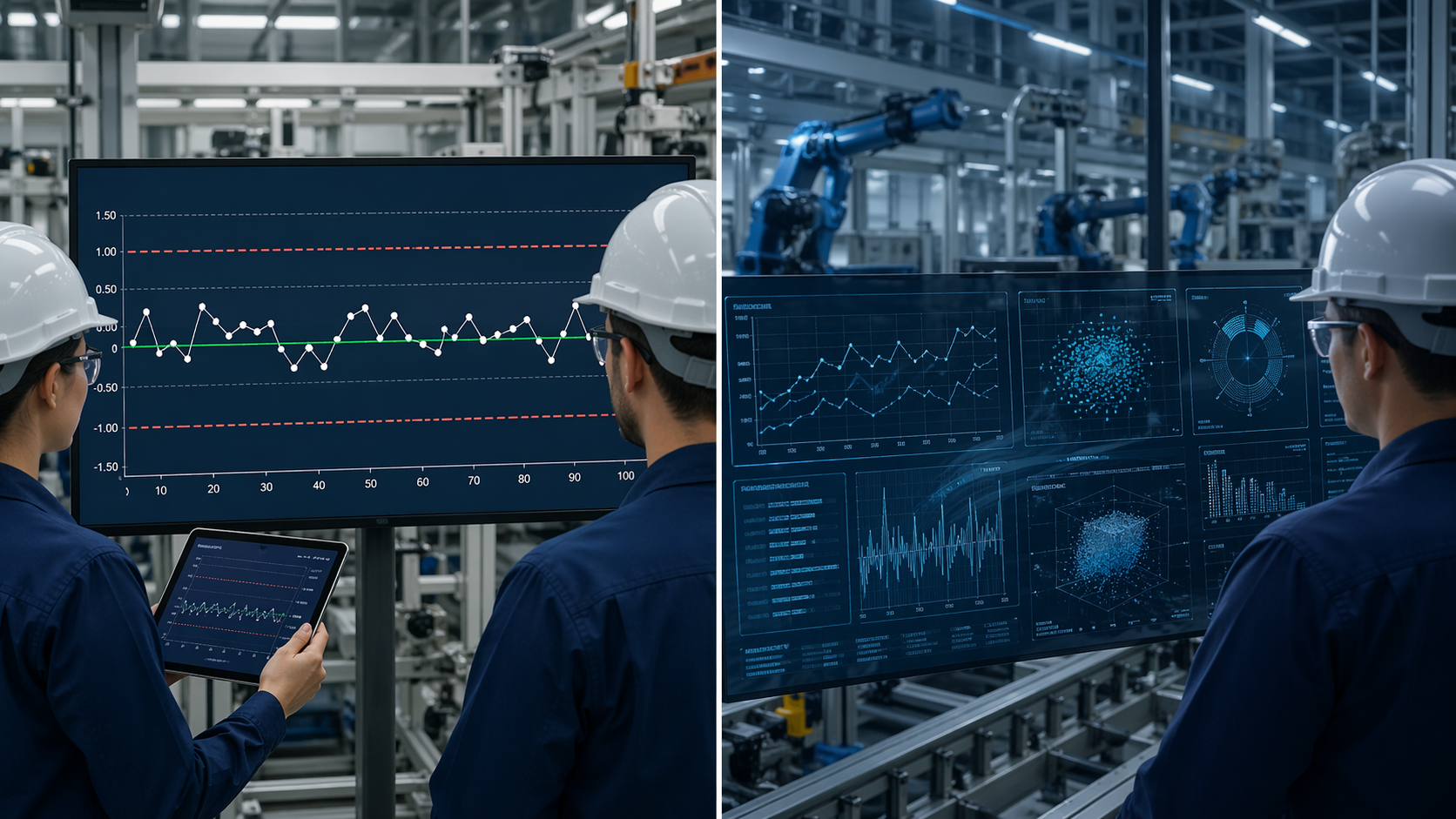
Leadership has seen the demos. AI-powered defect detection. Predictive maintenance. Root cause analysis in seconds, not days.
The question on your desk isn’t whether to adopt machine learning. It’s whether SPC still matters once you do.
It does. Skip that conversation and you’ll find out the hard way.
ML models don’t arrive knowing what “good” looks like. They learn it from your data. If that data carries noise — manual entry errors, paper-based gaps, measurements missing metadata — the model doesn’t filter it out. It learns it.
It finds patterns in the chaos and calls them signals. False positives stack up. Operators stop trusting the alerts. The investment quietly fails.
SPC isn’t the old way. It’s the prerequisite.
The idea that ML replaces SPC misunderstands what each tool is built to do.
SPC defines what normal looks like for your specific process — your Line 3 press, your 6 AM shift, your current material lot. It separates variation that needs a response from variation that doesn’t. Without that separation, teams adjust processes in response to noise. They introduce instability while trying to eliminate it.
ML doesn’t solve this problem. It inherits it.
What ML genuinely adds is the ability to predict at a scale SPC wasn’t built for. A well-trained model can spot a combination of five variables — none of which individually breaks a control limit — that preceded a failure mode in over 80% of historical cases. It can surface that pattern before the defect occurs. That’s a gap SPC doesn’t close.
But the model needs clean, contextualized, statistically verified data. At least 12 months of records tagged with machine ID, operator, shift, material lot, tooling age, and environmental conditions. A process that was in statistical control when those records were generated.
If it weren’t, the model would learn an unstable baseline. Accuracy degrades as conditions change.
SPC produces exactly that data. When it’s running well, it creates the ideal training set. Layer ML on top, and you get what neither tool delivers alone: real-time monitoring of known variables, and prediction of failure patterns too complex for any single control chart.
The failure pattern is consistent. A manufacturer invests in an ML platform. They pull historical data from MES exports, spreadsheet logs, paper records digitized after the fact. Training starts.
The model produces outputs. Some are useful. Enough are wrong that floor operators start working around the alerts instead of acting on them.
Model drift sets in. The process evolves. The training data no longer reflects current conditions. Retraining requires clean new data — which still doesn’t exist. The ML investment stalls.
Root cause is almost always the same: the process was never in statistical control before the model was trained.
In regulated environments, there’s a second problem. IATF 16949 requires documented SPC implementation — not ML outputs or BI dashboards. FDA 21 CFR Part 11 and cGMP require validated, traceable process records. NADCAP and AS9100 require real-time process verification with full audit trails.
A data strategy built on ML without an SPC layer doesn’t satisfy those requirements. It creates audit exposure.
When both tools run in the right sequence, outcomes shift from reactive to predictive:
The manufacturers who have made ML work — multi-plant food producers, aerospace suppliers, automotive tier ones with 20-plus-year quality programs — all followed the same sequence. SPC first. ML second, once the foundation produces training data worth trusting.
That isn’t conservatism. It’s the result of watching the alternative fail. A model that produces two or three wrong predictions loses the floor’s trust. Once that trust is gone, it doesn’t come back.
The readiness criteria are clear:
If those conditions aren’t in place, ML won’t solve the data problem. It will run more expensively on bad data.
The question isn’t which one. It’s whether the foundation is in place to make ML work.
SPC tells you whether your process is behaving normally right now. ML tells you what your process is likely to produce next. Those are different questions. You need answers to both.
The manufacturers running both effectively aren’t doing it because they had a large budget. They built it in the right order.
Start with SPC. Stabilize the process, clean the data, and establish the baselines. When the foundation is solid, layer ML on top. When both run from the same verified data stream, you get real-time monitoring and predictive capabilities together—and the compliance record to back it up.
Hertzler’s GainSeeker Suite and GS Premier are built on that foundation layer. GainSeeker integrates directly with MES systems, PLCs, and CMMs, applying SPC logic at the point of measurement. GS Premier brings cloud-based SPC with built-in conversational AI for teams that want real-time process intelligence without the infrastructure overhead. Talk to a Hertzler expert or request a demo.
Explore more resources from Hertzler:
GS Premier Cloud-based SPC with built-in conversational AI for real-time process intelligence.

Phil Mason, MBA (August 2026): Phil joined Hertzler Systems Inc. as VP of Business Development in January 2010 and was named President in June 2026.
Links: LinkedIn Quality Magazine FinalScout


